

The iPhone 15 and iPhone 15 Plus are the same phone in two sizes. Both run the A16 Bionic chip, the same 48MP camera system, Dynamic Island, and USB-C, so the only real differences are screen size, battery life, weight, and price. The iPhone 15 has a 6.1-inch display, weighs 171 grams, and is rated for up to 20 hours of video playback. The iPhone 15 Plus has a 6.7-inch display, weighs 201 grams, and lasts up to 26 hours. Choose the iPhone 15 if you want a lighter, more compact, lower-priced phone; choose the Plus if you want the bigger screen and longer battery.
According to RefurbMe's own tracking, a refurbished iPhone first appears on the market a median of around 82 days after Apple's release (Time-to-Refurb, as of July 2026), so both of these 2023 models have been widely available refurbished for well over a year and now sit deep in their discount curve. See the live figures on our iPhone refurbished stats page. This guide breaks down every difference so you can decide which size to buy.
Table of contents
- iPhone 15 vs. iPhone 15 Plus: Specs comparison table
- Reasons to choose the iPhone 15
- Reasons to choose the iPhone 15 Plus
- iPhone 15 vs. iPhone 15 Plus: Key differences
- Which iPhone 15 model should you buy?
- FAQ
- Conclusion
iPhone 15 vs. iPhone 15 Plus: Specs comparison table
| Feature | iPhone 15 | iPhone 15 Plus |
|---|---|---|
| Dimensions | 147.6 x 71.5 x 7.8 mm 5.81 x 2.82 x 0.31 in | 160.9 x 77.8 x 7.8 mm 6.33 x 3.06 x 0.31 in |
| Weight | 6.02 oz 171 grams | 7.09 oz 201 grams |
| Screen size | 6.1 inches | 6.7 inches |
| Display type | Super Retina XDR, OLED | Super Retina XDR, OLED |
| Resolution | 2556 x 1179 pixels | 2796 x 1290 pixels |
| Pixel density | 461 PPI | 460 PPI |
| Brightness | Up to 2,000 nits (peak) | Up to 2,000 nits (peak) |
| Refresh rate | 60Hz | 60Hz |
| Processor | A16 Bionic | A16 Bionic |
| RAM | 6 GB | 6 GB |
| Storage options | 128GB, 256GB, 512GB | 128GB, 256GB, 512GB |
| Main camera | 48MP Wide + 12MP Ultra Wide | 48MP Wide + 12MP Ultra Wide |
| Front camera | 12MP TrueDepth | 12MP TrueDepth |
| Battery capacity | 3,349mAh | 4,383mAh |
| Battery life | Up to 20 hours video playback | Up to 26 hours of video playback |
| Charging | 20W wired, MagSafe and Qi wireless | 20W wired, MagSafe and Qi wireless |
| Connector | USB-C (USB 2.0) | USB-C (USB 2.0) |
| Max OS compatibility | iOS 27 | iOS 27 |
| Face ID | Yes | Yes |
| 5G support | Yes | Yes |
| Water resistance | IP68 | IP68 |
| Colors | Black, blue, green, yellow, pink | Black, blue, green, yellow, pink |
| Price (refurbished) | Starting at | Starting at |
Reasons to choose the iPhone 15

128GB storage
Pink

128GB storage
Black
- Easier to handle with one hand due to its compact 6.1-inch form
- Lighter weight at 171g, making it more portable throughout the day
- Lower price while delivering the same chip, cameras, and software features
- Slips comfortably into any pocket or small bag
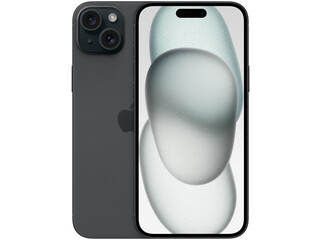
Reasons to choose the iPhone 15 Plus
128GB storage
Black

- Larger 6.7-inch display for a more immersive media and gaming experience
- Higher resolution screen (2796 x 1290) for sharper, more detailed visuals
- Substantially longer battery life with up to 26 hours of video playback
- Ideal for users who regularly stream content, game, or work on the go
iPhone 15 vs. iPhone 15 Plus: Key differences
While the iPhone 15 and iPhone 15 Plus share the same chip, cameras, and software, several important distinctions will shape your day-to-day experience. Here is a closer look at each one.
1. Design and Dynamic Island
Both the iPhone 15 and iPhone 15 Plus mark a meaningful design evolution from their predecessors. The most visible change is the arrival of Dynamic Island, Apple's interactive pill-shaped cutout that replaces the old notch found on the iPhone 14. Dynamic Island integrates alerts, timers, music controls, and live activities directly into the display, making the space around the front camera genuinely useful rather than dead space.
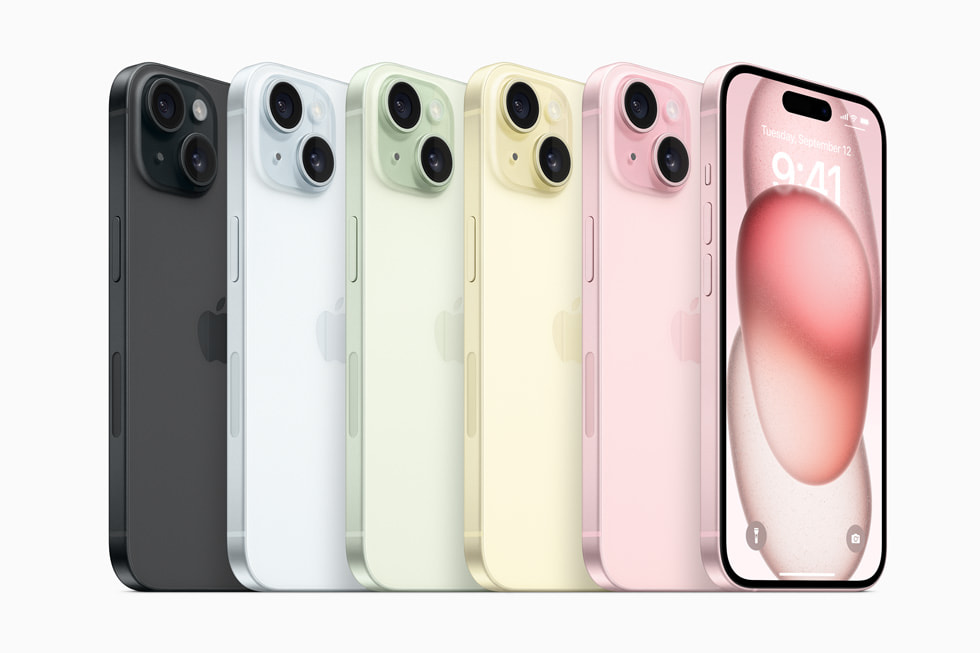
Both phones share an aluminum frame, a Ceramic Shield front glass, and a color-matched glass back available in five finishes: black, blue, green, yellow, and pink. The design language is identical between the two models; the only physical difference is scale. The Plus is simply larger in every dimension while maintaining the same thickness of 7.8mm.
2. Screen size and display
One of the most consequential differences between the iPhone 15 and the iPhone 15 Plus is screen size.
The iPhone 15 features a 6.1-inch OLED display with a resolution of 2556 x 1179 pixels (461 PPI), while the iPhone 15 Plus offers a 6.7-inch screen at 2796 x 1290 pixels (460 PPI).
Despite the difference in physical size, pixel density is virtually identical on both models, so sharpness is not a deciding factor. What differs is the sheer canvas: the Plus gives you noticeably more room for reading, video, and multitasking. Both screens reach up to 2,000 nits of peak brightness, handle HDR content well, and share the same 60Hz refresh rate, which is notably lower than the 120Hz ProMotion display found on the Pro lineup.
If you frequently watch films, play games, or use your phone as a reading device, the larger screen of the Plus will feel like a meaningful upgrade. If you primarily text, browse, and take photos, the 6.1-inch panel on the standard iPhone 15 will serve you just as well in a more manageable package.
3. The iPhone 15 is lighter and more pocketable
The size difference between these two phones is substantial enough to affect everyday comfort.
The iPhone 15 weighs 171 grams and measures 147.6 x 71.5 x 7.8mm, while the iPhone 15 Plus weighs 201 grams and stretches to 160.9 x 77.8 x 7.8mm. That is a 30-gram difference and nearly 1.5cm of extra height.
For users who prefer one-handed operation, the iPhone 15 is the clear winner. Its narrower frame allows your thumb to reach most of the screen without readjusting your grip. The Plus, by contrast, generally requires two hands for comfortable navigation, particularly if your hands are on the smaller side.
Both phones carry the same IP68 water resistance rating, meaning they can handle submersion in up to 6 meters of water for 30 minutes, so neither has an edge in durability.
4. Battery life and charging
Battery life is arguably the single most compelling reason to consider the Plus model.
The iPhone 15 Plus packs a 4,383mAh battery capable of up to 26 hours of video playback, compared to the iPhone 15's 3,349mAh cell rated for up to 20 hours. In real-world use, many Plus owners report being able to stretch the phone to nearly two full days between charges with moderate usage, while the standard iPhone 15 comfortably covers a full day.
Both models charge at the same speeds: up to 20W via wired USB-C and up to 15W wirelessly via MagSafe. With a 20W adapter or higher, either phone can reach 50% charge in approximately 30 minutes. The USB-C port on both models supports USB 2.0 data transfer speeds, which is slower than what the Pro models offer, but perfectly adequate for everyday use.
Both phones are compatible with Qi2 wireless charging accessories, and the entire MagSafe ecosystem of cases, wallets, and chargers works identically across both sizes.
5. Camera system
The camera hardware on the iPhone 15 and iPhone 15 Plus is completely identical, which is notable given that Plus-sized iPhones have historically offered camera parity rather than upgrades. Both phones feature:
- 48MP main sensor (Sony IMX904, f/1.6 aperture, sensor-shift OIS, PDAF) with support for 2x optical-quality zoom and 24MP default capture
- 12MP Ultra Wide (f/2.4 aperture)
- 12MP TrueDepth front camera with autofocus
The 48MP sensor is a significant upgrade over the 12MP main cameras found in earlier iPhone generations. It enables detailed close-up shots, flexible cropping, and Apple's Photonic Engine computational photography pipeline. Both phones record 4K video at up to 60fps, support Dolby Vision HDR, and include Cinematic mode for shallow-depth-of-field video capture.
Neither model includes a dedicated telephoto lens, which is a key differentiator between the standard and Pro lines. If optical zoom beyond 2x is important to you, the iPhone 15 vs. iPhone 16 comparison might be worth reading before you commit.
6. Performance and software
Both phones are powered by the A16 Bionic chip, the same processor that debuted in the iPhone 14 Pro the year before. With 6GB of RAM and Apple's tightly integrated software stack, both models deliver fast, fluid performance in apps, gaming, and multitasking. There is no performance difference between the two models whatsoever.
Both shipped with iOS 17 and run iOS 27, the current release since September 14, 2026, giving them a long software lifespan. Apple typically provides five to six years of iOS support, so either phone will remain relevant for years to come. One caveat: neither the standard iPhone 15 nor the 15 Plus supports Apple Intelligence, which requires the A17 Pro chip or newer (found in the iPhone 15 Pro and the iPhone 16 line onward). Both still receive every other iOS 26 feature and security update.
Which iPhone 15 model should you buy?
The decision ultimately comes down to three factors: screen size preference, battery priority, and budget.
Choose the iPhone 15 if:
- You value one-handed use and a lighter, more compact phone
- Your day-to-day battery needs are moderate
- You want the best value at the lower price point
Choose the iPhone 15 Plus if:
- You stream a lot of video, play games, or work on your phone for extended periods
- Battery anxiety is a real concern and you want a phone that comfortably lasts two days
- You are comfortable with a larger phone and enjoy the extra screen real estate
Both are excellent choices, and refurbished models of each are widely available at significantly reduced prices compared to new retail. On RefurbMe, you can compare certified refurbished listings side by side across trusted sellers. For US buyers, Back Market and Gazelle usually post the best value on refurbished iPhone 15 and 15 Plus units, with Amazon Renewed and eBay Refurbished worth checking as well, while Apple's own Certified Refurbished store is the reassurance benchmark to price against. Compare all of them on the refurbished iPhone page.
FAQ
Conclusion
The choice between the iPhone 15 and iPhone 15 Plus boils down to how you use your phone daily.
Crave a larger, more immersive display and need a battery that lasts well beyond a single day? The 15 Plus is your answer. Prefer a lighter, more pocketable device without sacrificing performance or cameras? The 15 has you covered.
Both models bring Dynamic Island, a 48MP camera, USB-C, and the A16 Bionic chip to the table. Neither compromises on performance. The only meaningful trade-offs are size, weight, and battery endurance.
Related comparisons:
Consider a refurbished iPhone 15 or iPhone 15 Plus. On RefurbMe, we compare prices from trusted sellers and only feature refurbished iPhones with a warranty, ensuring you get the best deal on a high-quality device that works like new.
128GB storage
Pink
128GB storage
Black
Last updated: Sep 15, 2026 · First published: Jun 25, 2024