



The MacBook Air M2 comes in two sizes, a compact 13-inch released in 2022 and a larger 15-inch introduced at WWDC 2023, and the choice between them is less obvious than it looks. On paper they share the same M2 chip, the same fanless design, and the same base configurations. In practice, they feel like meaningfully different machines the moment you open the lid.
This guide breaks down every real-world difference: screen size and portability, GPU tiers, the often-overlooked thermal behaviour, the speaker gap, and what each model costs refurbished in 2026. By the end you will know exactly which one to buy.
Short answer
The 13-inch and 15-inch MacBook Air M2 run the same M2 chip and the same ports. The 15-inch adds three things the 13-inch lacks at its base price: a standard 10-core GPU (vs 8-core), a six-speaker sound system with force-canceling woofers (vs four), and a larger 66.5 Wh battery. Buy the 13-inch for portability and a lower price. Buy the 15-inch for more screen, better sound, and steadier sustained performance. Refurbished, the 13-inch is the cheaper of the two.
Note on chip generations: Apple has since launched the M3 and M4 MacBook Air lines. The M2 models remain excellent value, especially refurbished, but if you want the newest silicon, check out our MacBook Air M4 vs. MacBook Pro M4 comparison.
Table of contents
- Key Differences at a Glance
- Specs Comparison
- Which Should You Buy?
- Is the M2 MacBook Air Still Worth It in 2026?
- FAQ
Key Differences at a Glance
| Feature | 13-inch MacBook Air M2 | 15-inch MacBook Air M2 |
|---|---|---|
| Display | 13.6-inch Liquid Retina | 15.3-inch Liquid Retina |
| Resolution | 2560 x 1664 (224 ppi) | 2880 x 1864 (224 ppi) |
| Dimensions | 11.97 x 8.46 x 0.44 in / 30.41 x 21.5 x 1.13 cm | 13.4 x 9.35 x 0.45 in / 34.04 x 23.76 x 1.15 cm |
| GPU | 8-core (upgradeable to 10-core) | 10-core (standard) |
| Speakers | 4-speaker sound system | 6-speaker system with force-canceling woofers |
| Battery capacity | 52.6 Wh | 66.5 Wh |
| Battery life (Apple) | Up to 18 hours video playback | Up to 18 hours video playback |
| Power adapter | 30W USB-C (35W dual with 10-core) | 35W dual USB-C |
| Weight | 2.7 lbs / 1.24 kg | 3.3 lbs / 1.51 kg |
| Price (new, at launch) | From $1,099 | From $1,299 |
| Price (refurbished) | Starts at | Starts at |
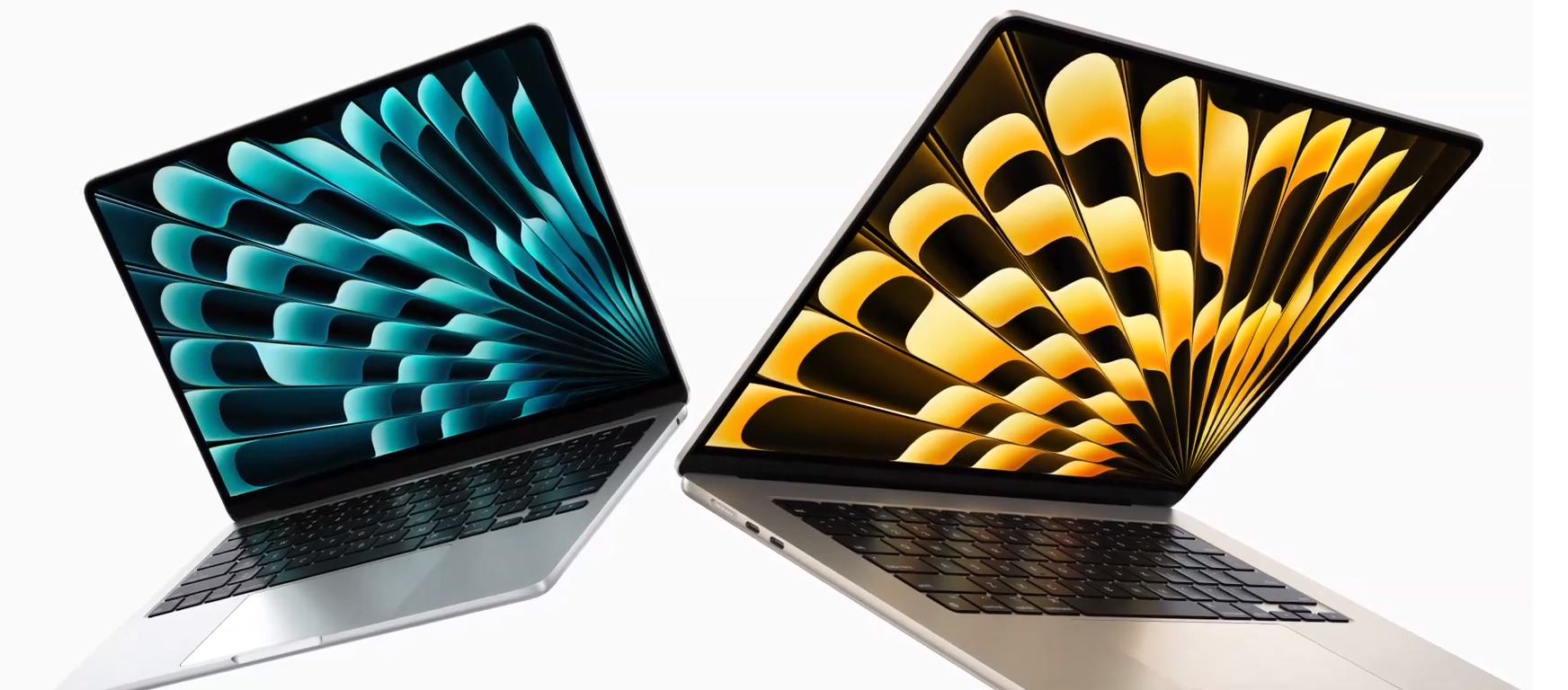
MacBook Air M2 13″ and 15″ Image credit: Apple
Specs Comparison
Dimensions and design
The size difference is the most immediate thing you notice. The 13-inch measures 11.97 x 8.46 x 0.44 inches and weighs 2.7 pounds, while the 15-inch measures 13.4 x 9.35 x 0.45 inches and weighs 3.3 pounds. That 0.6-pound gap sounds trivial on a spec sheet but becomes real after a full day in a bag.
Both models share the same flat-wedge design that Apple overhauled in 2022, trading the tapered silhouette of older Airs for uniform thickness. The result is a laptop that feels intentionally minimal: no fan vents, squared-off edges, and a lid that opens with one finger. Apple claims the M2 Air is nearly 40% thinner than a comparable PC laptop at the same price point.
Color options are identical across both sizes: Midnight, Starlight, Space Gray, and Silver. The only visual tell is footprint: the 15-inch footprint is closer to a 14-inch MacBook Pro than to a 13-inch laptop, so measure your bag or desk before committing.
👉 Related: Are MacBooks Worth It? How to Get the Best MacBook
Display
Both screens use the same Liquid Retina technology at the same 224 pixels-per-inch density, so sharpness is not a differentiator. What changes is the canvas. The 13-inch offers 2560 x 1664 pixels across 13.6 inches, while the 15-inch delivers 2880 x 1864 pixels across 15.3 inches.
The practical benefit of the larger screen shows up during real work: side-by-side windows, spreadsheets with many columns, and photo editing all feel less cramped on the 15-inch. If you regularly connect an external monitor at your desk, the difference matters less day-to-day. If the MacBook is your only display, whether at a coffee shop, on a plane, or in a lecture hall, those extra two inches of real estate are genuinely useful.
Peak brightness, color gamut (P3 wide color), and True Tone support are identical on both. Neither model supports ProMotion (120 Hz refresh), which remains a MacBook Pro feature.
👉 Learn more: 21 Best Mac Apps
GPU and graphics
Here is the one hardware difference that is easy to miss. The 13-inch base model ships with an 8-core GPU, while the 15-inch comes standard with a 10-core GPU. You can configure the 13-inch with the 10-core option at checkout, but you will pay extra to reach parity with what the 15-inch includes by default.
In benchmarks the 10-core GPU scores roughly 20% higher in GPU-bound tasks, including video editing on Final Cut Pro, photo retouching in Lightroom, or running Apple Arcade titles. For everyday browsing, email, and documents the 8-core is more than sufficient. The shared 16-core Neural Engine is identical across all configurations and handles on-device machine learning tasks equally well.
Both models support one external display up to 6K at 60 Hz via Thunderbolt, or up to 5K at 60 Hz over DisplayPort. Neither supports two simultaneous external displays natively, a limitation you only hit if you run a dual-monitor desk setup.
Thermals: the hidden difference
This is the detail that most comparison articles skip, and it matters more than it might seem. Both the 13-inch and 15-inch MacBook Air M2 are fanless. They rely entirely on passive cooling through the aluminum chassis. Under sustained CPU-heavy workloads, the chip will eventually throttle to stay within thermal limits.
The 15-inch has an advantage here: its larger chassis dissipates heat across a bigger surface area. In sustained performance tests, the 15-inch throttles less aggressively than the 13-inch under identical loads. The keyboard, which sits above the chip, also runs cooler on the 15-inch, which some users notice during long editing sessions.
For typical usage (web browsing, video calls, light coding, writing) neither machine gets noticeably warm. The thermal gap only shows up during prolonged export jobs or extended gaming. If your work regularly involves hour-long Final Cut renders, the 15-inch is the more comfortable choice. For everything else, the difference is academic.
Speakers and audio
The audio gap between these two models is one of the clearest differences. The 13-inch has a four-speaker sound system, while the 15-inch has a six-speaker system with two force-canceling woofers. The 15-inch produces noticeably more bass and volume. It is a genuine upgrade for music, movies, and video calls, not just a marginal improvement.
If you listen to music or watch content at your desk without headphones, the 15-inch speaker system is among the best built into any thin laptop. The 13-inch sounds good for its size but lacks the low-frequency presence. For anyone who uses their MacBook as a secondary speaker, whether during video calls, travel, or in a kitchen, this difference alone can justify the size upgrade.
Battery and charging
Apple rates both models at up to 18 hours of Apple TV app movie playback and up to 15 hours of wireless web browsing. The 15-inch achieves those numbers with a larger 66.5 Wh battery versus the 13-inch's 52.6 Wh pack, and the bigger battery compensates for the larger, more power-hungry screen.
In real-world mixed usage both laptops comfortably last a full work day. The 15-inch holds a slight edge in very light usage scenarios (document editing, video streaming at low brightness), but you are unlikely to notice the difference on a typical day.
On charging, the 13-inch base model comes with a 30W USB-C adapter. The 10-core GPU configuration gets a 35W dual USB-C adapter, as does the 15-inch standard configuration. Both support fast charging with an optional 70W USB-C adapter, reaching approximately 50% charge in 30 minutes. MagSafe 3 is available on both and remains the most convenient daily charging option.
Pricing and refurbished value
At launch, the 13-inch M2 Air started at $1,199 (8-core GPU, 8 GB RAM, 256 GB SSD) and the 15-inch at $1,299, a $100 gap for the larger screen, better speakers, and a standard 10-core GPU.
In 2026, both models are widely available refurbished at meaningfully lower prices. Buying a certified refurbished M2 Air delivers the same M2 performance, the same display, the same ports, all at a fraction of the original cost. The M2 MacBook Air is one of the most cost-effective refurbished laptops available today.
The cheapest way to buy one is to compare every seller in a single view. On RefurbMe, Back Market typically lists the most competitive refurbished M2 Air prices, with Amazon Renewed and the Apple Certified Refurbished store available as alternatives when you want a specific grade or warranty. Comparing them side by side is how you avoid overpaying for the same machine.
Compare refurbished MacBook Air M2 prices
See live prices from Back Market, Amazon Renewed, Apple, and more certified sellers in one place.
Compare prices👉 Related: 7 Best Refurbished MacBooks in 2026
Which Should You Buy?
The right answer depends on two things: how you carry your laptop and what you do with it.
Choose the 13-inch if:
- You commute daily and weight matters
- You use a bag or backpack that is tight on space
- You mostly do light tasks: writing, browsing, email, video calls
- Budget is a priority and you want maximum portability per dollar
- You regularly use an external monitor at a desk
Choose the 15-inch if:
- The MacBook is your only screen and you do real work on it
- You edit video, work with large spreadsheets, or do design work
- You listen to music or watch content without headphones
- You want the 10-core GPU without paying extra to configure it
- Sustained performance under load matters to you
The functionality of these two laptops is nearly identical. Both run the same M2 chip, both offer the same ports (two Thunderbolt 4, MagSafe 3, headphone jack), and both support identical software. The 15-inch is not a "more powerful" machine in any meaningful way for most users. It is a "more comfortable" machine for those who spend extended time on it.
Is the M2 MacBook Air Still Worth It in 2026?
Yes, with context. Apple has launched M3 and M4 MacBook Air generations since the M2 models shipped, and the M4 is a notable step up in CPU performance and memory bandwidth. If you are buying new, the M4 is the better long-term investment.
But for refurbished buyers, the M2 MacBook Air offers outstanding value. The M2 chip still handles virtually every creative and productivity task without friction. macOS continues to support it fully. The design is identical to current models. And refurbished M2 Airs are now priced well below what M3 and M4 models cost, making them one of the most compelling value propositions in the laptop market.
The one caveat: the 8 GB base RAM configuration shows its limits in 2026 with multiple browser tabs, large Xcode projects, or running local AI models. If you are buying used, prioritize the 16 GB RAM variant for longevity.
👉 See also: Are Refurbished MacBooks Good? Pros and Cons
Check out all available 13-inch MacBook Air M2 models:

Apple M2 with 8-core CPU, 8-core GPU
8GB memory • Midnight
with Touch Id • 2022 release

Apple M2 with 8-core CPU, 8-core GPU
8GB memory • Silver
with Touch Id • 2022 release

Apple M2 with 8-core CPU, 8-core GPU
8GB memory • Space Gray
with Touch Id • 2022 release
And all available 15-inch MacBook Air M2 models:

Apple M2 with 8-core CPU, 10-core GPU
8GB memory • Midnight
with Touch Id • 2023 release

Apple M2 with 8-core CPU, 10-core GPU
8GB memory • Space Gray
with Touch Id • 2023 release

Apple M2 with 8-core CPU, 10-core GPU
8GB memory • Starlight
with Touch Id • 2023 release
FAQ
Last updated: Jun 15, 2026 · First published: Jun 23, 2023


